GALLERY

Crushing and grinding machine
for mines and quarries
On the following pages we offer a large variety of pictures of machines built by SBM Machinery. For more information on the individual machines please visit our products pages. Our gallery categories can be selected on the menu to the left.
Crushing Equipment


International Cooperation
ادامه مطلب
Impact crusher for Silica sand processing

Silica sand processing line
Silica sand processing line with crushing, screening, washing equipment is widely used in kinds of silica sand mine.
The mined mineral from silica sand deposit quarry will be fed into jaw crusher or impact crusher for primary crushing, after primary crushing, the crushed silica sand will be fed into cone crusher and VSI crusher for fineness crushing.
After crushing, the crushed silica sand will be sieved into different grades by vibrating screen. And washing plant will clean up the crushed silica sand by grades.
After crushing, most of sand grains from the processing line is 0.1-0.5 mm in diameter, 0.5-1mm,1-1.5mm is available.
Impact crusher for Silica sand processing line
Impact crusher is an ideal crushing equipment for hard abrasive mineral like silica sand.
PF(W) series horizontal impact crusher has very high reduction ratio, very good cubical shape and the crusher is less sensitive to sticky material than other machines.
VSI series vertical shaft impact crusher has improved energy efficiency, crushing performance and control, it also has superior cubically shaped product and lower costs.
Impact crusher from SBM Machinery can process silica sand at 600 TPH, and final grain size varies from 0.1 mm to 4mm.

FLOAT GLASS
Float glass is manufactured through a process developed by Pilkington in 1959, taking flat glass technology to a revolutionary new level. The glass gains its lustrous finish and perfect flatness by floating on a bath of molten tin in a chemically controlled atmosphere. The ribbon of glass is then cooled, while still moving, until the surfaces are hard enough for it to be taken out of the bath without the roller marking the surface. The glass is then automatically cut and stacked, ready to be packed for distribution.
The Float Line
- Raw material feed
- Sand, soda ash, dolomite, limestone and a proportionate amount of cullet are combined to form a batch. Strict quality controls and monitoring of temperatures throughout the process maintain high quality standards.
- Furnace
- Batch materials are fed into the furnace. Full melting is achieved at around 1600°C.
- Float bath
- A continuous ribbon of molten glass floats along the surface of molten tin. Irregularities are melted out, ensuring flat, parallel surfaces in the glass.
- Annealing lehr
- The glass is annealed and gradually cooled to 200°C, to relieve stresses and prevent splitting and breaking in the cutting phase.
- Cutting
- The glass ribbon is cut automatically as it moves along the rollers.
- Stacking and offloading
- A series of automatic stackers offload the glass. The glass is then warehoused for distribution, using overhead cranes and mobile lifting vehicles.
|
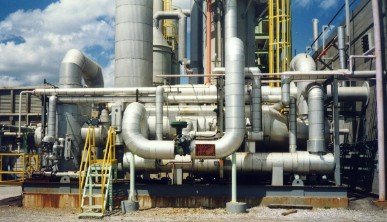
Liquid sulphur dioxide (SO2) is a versatile chemical with many uses, both in liquid form or as a source of gaseous SO2. Liquid SO2 is used the pulp and paper industry, mining industry, and in the food industry as a preservative. It can function as a reducing agent, an oxidizing agent, a pH controller, purifying agent, preservative, a germicide and bleaching agent. SO2 can also be used as a refrigerant, heat transfer fluid and selective solvent.
Liquid SO2 can be produced from gas containing SO2 concentration in the range of 1% to 100% using different processes.
Production
There are several different processes for the production of liquid SO2:
- Compression and Condensing
- Partial Condensation
- Absorption and Acidification
- Sulphur Trioxide and Sulphur
Compression and Condensing
At atmospheric pressure, pure SO2 will begin to condense at –10.1°C (13.9°F). If the gas is compressed to 388 kPa(g) (56.3 psig), SO2 will begin to condense at 32.2°C (90°F). This temperature is high enough that normal cooling water can be used to condense SO2.
When the concentration of SO2 is less than 100%, the gas must be compressed to higher pressures to obtain a high enough condensing temperature to use cooling water as the condensing medium.
The tail gas leaving the system may be further cooled in a refrigeration unit to achieve nearly 100% or full condensation of the SO2.
Partial Condensation
When the concentration of SO2 in the gas is low (typically 7-14%), it becomes impractical to attempt to fully condense all the SO2 contained in the gas. Extremely high pressures are required in order to use cooling water to condense SO2 from the gas. The alternative to full condensation is partial condensation of the SO2 is using refrigeration only. Refrigeration systems can achieve temperatures as low as –55°C (-67°F). Typically, only 50% of the SO2 can be condensed from the gas. The tail gas from the refrigeration process in used to pre-cool the incoming gas prior to being directed to some other process, such as a sulphuric acid plant, for further treatment.
Absorption and Acidification
Gas containing low concentrations of SO2 (typically 1-2% vol) is scrubbed using an ammonia solution to form ammonium bisulphite according to the following reaction:
SO2(g) + NH4OH = NH4HSO3
The ammonium bisulphite solution is reacted to sulphuric acid to form ammonium sulphate, water and SO2.
2 NH4HSO3 + H2SO4 à (NH4)2SO4 + 2 H2O + 2 SO2(g)
The SO2 is stripped from the ammonium sulphate solution and is directed to liquid SO2 production. The gas containing essentially 100% SO2 and moisture is first dried by condensing water from the gas and then drying the gas using concentrated sulphuric acid. The dried SO2 gas is compressed and then condensed using cooling water.
An absorption and acidification process has been operating at Cominco’s metallurgical facility since 1931. The production of liquid SO2 is unfortunately tied stoichiometrically to the production of ammonium sulphate.
Sulphur Trioxide and Sulphur
Pure sulphur trioxide (SO3) will react with solid sulphur to produce SO2. SO3 can be obtained by distilling oleum to drive off SO3 gas. The SO3 passes through a column packed with solid sulphur to produce SO2 out the top of the column.
Product Specification
A typical product specification for liquid SO2 is as follows:
| Purity | 99.90% (min) |
| Acidity | 25 ppm (max) |
| Moisture | 100 ppm (max) |
| Residue | 100 ppm (max) |
| Sulphur | 5 ppm (max) |
Liquid SO2 produced from sulphur burning acid plants is generally able to meet the above criteria. It will be more difficult but not impossible to meet the above requirements in a metallurgical acid plants. An efficient gas cleaning system is required to achieve the specification.
Liquid SO2 can be shipped in a number of different ways. Small quantities are available in 68 kg (150 lb) cylinders similar to cylinders for welding gases. The rate of delivery will depend in the temperature of the liquid SO2 in the cylinder. In order for gas to continue to be produced some liquid SO2 must vapourize but vapourization of liquid SO2 will cool the remaining liquid SO2 reducing the pressure in the cylinder. The overall rate of SO2 gas discharge will depend on the heat transfer rate from the surroundings through the walls of the cylinder. At room temperature a discharge rate of about 0.9 kg/h (2.0 lb/h) of gaseous SO2 is possible.
Larger quantities of liquid SO2 are available in one tonne containers.
Bulk storage of liquid SO2 can be done in large horizontal cylindrical pressure vessel specifically design for the service. These storage tanks can be designed to hold several hundred tonnes to thousands of tonnes of liquid SO2.
Bulk shipments of liquid SO2 are done using either rail tank cars or tank trucks.
Normally, heavy walled (i.e. schedule 80) seamless carbon steel pipe will be used to handle liquid SO2. If SO2 is produced using the refrigeration method, extremely low operating temperatures are involved. In this case the material must have adequate notch toughness to eliminate the risk of low temperature embrittlement. If the piping is installed where the ambient temperature can get very low, the requirement for adequate notch toughness is also required.
Flanges should be 300 lb. ANSI rated.
Screwed joints should be avoided but if it is necessary to have screwed connections, they should be back welded.


Product Details
|
||||||||||||||
| Lehr | ||||||||||||||
适用范围
<'%=rs("note")%>
-->
Product ID: 4141322514
Product Name: Lehr Product Category: Lehr Clicks: 564 >> Details
| ||||||||||||||

ادامه مطلب
|
|
| Floor Pull edge machine |

|
||||||||||||||
| All Automatic Suspended Top Roll | ||||||||||||||
适用范围
<'%=rs("note")%>
-->
Product ID: 8114212314 Product Name: All Automatic Suspended Top Roll Product Category: Automatic hang-pull machine Clicks: 946 >> Details
|

ادامه مطلب
|
||||||||||||||||||||||
| Large Leaning Blanket Batch Charger | ||||||||||||||||||||||
适用范围
<'%=rs("note")%>
-->
| ||||||||||||||||||||||

| |||||||||||||||||||||
ادامه مطلب


|
Main Technical data and performance
|
A
PROCESS TO RECYCLE THIN FILM PV MATERIALS
Robert E. Goozner, William F. Drinkard, Mark O. Long and Christi M. Byrd
Drinkard Metalox, Inc., 2226
N. Davidson Street,
Charlotte, NC
28205
26TH IEEE PHOTOVOLTAIC SPECIALISTS CONFERENCE
ANAHEIM CALIFORNIA
29 SEPTEMBER - 03 OCTOBER 1997
ABSTRACT
INTRODUCTION
There is wide scale interest in the commercial potential and wide scale use of cadmium and cadmium telluride (CdTe) and copper indium diselenide (CIS) photovoltaic modules. These type of thin film devices have demonstrated advantages which include good performance, the ability to be manufactured by various methods and apparent environmental stability. There are currently several efforts underway in the United States and abroad to manufacture thin film PV modules and commercialize them. The use of these modules would entail the use of toxic metals such as cadmium, selenium and (potentially) lead in their manufacture. The manufacture of thin film photovoltaic modules, as in the manufacture of any article, must address the associated environmental safety and health issues, as has been reviewed by P.D. Moskowitz et al. [1]. Government agencies, industry groups and private citizens will be placing greater emphasis on the requirement that emerging technologies will not endanger health, safety or the environment. This problem will become more acute in the future as large scale thin film photovoltaic production generates appreciable waste streams and superannuated photovoltaic modules. Cadmium and selenium continue to be regulated because of their toxicity. Since these metals are regulated in other industries, national standards must also be met in the manufacture of thin film photovoltaic modules.
An important problem in the field of photovoltaic (PV) technology is that there has been no process specifically designed to remove and recycle the metals in an environmentally benign fashion. The range of metals which can be present in thin film PV devices may include cadmium, copper, lead, gallium, indium, selenium and tellurium. The substrates they must be separated from are glass, plastic or similar low cost substrates.
|
Table 1. TCLP Results For PV Cells |
||||
|
Source |
Description |
Cd (mg/L) |
Se (mg/L) |
Pb (mg/L) |
|
#1 |
CdTe Laminate |
0.915 |
- |
0.038 |
|
#2 |
CIS Circuit |
0.079 |
0.283 |
37.5 |
|
#2 |
CIS Laminate |
0.098 |
0.404 |
0.503 |
|
#2 |
CIS Plates |
0.016 |
0.419 |
0.073 |
|
#3 |
CIS Plates |
0.213 |
0.254 |
0.107 |
|
#4 |
Si Laminate |
- |
- |
5.3 |
|
#4 |
Si Module |
- |
- |
6.5 |
|
EPA LIMITS |
1 |
1 |
5 |
|
The results in Table 1 show that the levels of Cd and Se are within current TCLP limits, although the Cd level for the CdTe cell is close to the limit. Repeated testing of CdTe cells will probably yield some results above the TCLP limit. An elevated level of lead was observed for the CIS cells. Further examination showed that this was from a lot of hand soldered prototypes, indicating that the method of mounting the PV laminate in the finished module (especially if lead containing solder is used) should always be evaluated. As a comparison, the TCLP results for Silicon PV cells showed TCLP levels slightly above the EPA limits of 5 mg/L for lead when both the laminate and complete module are tested. Although there are a number of ways that lead can be removed by leaching and precipitation processes, the utilization of lead free solder and solder free electrical connections should be considered for the manufacture of PV modules.
METAL RECOVERY PROCESSES
Alternative processes have been developed for the recovery of metals from scrap and superannuated CdTe and CIS modules. These processes are presented below.
CdTe CELL PROCESS
Figure 1 shows a process to recover metals from scrap CdTe modules.

The treatment process in Figure 1 is to treat the CdTe cells with a nitric acid based lixivant. This lixivant selectively oxidizes and solubilizes the Cd and Te while leaving the SnO2 conducting layer intact on the glass substrate. This will enable the reuse of the substrate in the manufacture of PV cells. Separation of the substrates from the lixivant separates out the Cd and Te. The lixivant is reused to process cells until a high Cd and Te loading is attained. Metal loadings in excess of 100 grams per liter are achievable. The subsequent treatment of the pregnant lixivant is to electrolyze the material with DC current. Proper selection of the current and electrode materials enabled the precipitation of tellurium metal on the cathode while leaving the cadmium in solution.
CIS CELL PROCESS
The processing of CIS cells can be considered to be more challenging due to the wider assortment of metals in these cells. The metals present in CIS cells can include copper, indium, selenium, cadmium, zinc and additionally lead from the electrical connections. This different assortment of metals (as compared to CdTe cells) led to the development of the recycling process outlined in Figure 2.

The treatment process in Figure 2
is to treat
the CIS cells with a nitric acid based lixivant. This lixivant
selectively
oxidizes and solubilizes the Cu, In, Se, Zn and other metals from the
substrate
while leaving the SnO2 conducting layer intact on the glass
substrate. The EVA plastic from the laminate will be hydrolyzed and
float to
the top of the lixivating solution where it can be retrieved for
disposal,
since the EVA plastic passes TCLP and requires no further treatment.
The
subsequent treatment of the pregnant lixivant is to electrolyze the
material
with DC current. Proper selection of the current and electrode
materials
enabled the two stage deposition of metal: the first being a Cu/Se
mixture and
the second being the residual cadmium. Electrolysis results for the
separation
of Cu/Se from Cd are shown in Table 2.
|
Table 2. Electrolysis Results For 10,000 ppm CIS Metals Solution. |
|||||
|
No. |
% Metals Removed From Solution |
||||
|
|
Cd |
Cu |
In |
Se |
Zn |
|
1 |
0 |
94 |
0 |
88 |
0 |
|
2 |
16 |
0 |
89 |
0 |
|
|
3 |
20 |
94 |
0 |
90 |
0 |
The results in Table 3. shows the selective separation of Cu/Se and Cd
on the
cathode while leaving the Zn and In solution. In full scale operation
the
electrolysis would be performed in a trough configuration having a
series of
electrodes, whereby the Cu/Se would plate out on the electrodes nearest
the
solution inlet and the Cd would plate out on the electrodes nearest the
solution outlet.
Oxidation and distillation of the Cu/Se mixture yields a pure SnO2 product. Decomposition of the lixivant will yield a mixture of indium, zinc and residual metal oxides which can be sold to a refiner or further treated via solvent extraction.
FURTHER WORK
Additional work is being performed on a combined CdTe/CIS recovery process and developing technology to combine these processes with current industrial selenium electrochemistry and cadmium processing technologies.
A pilot plant demonstration of the process on several barrels of PV waste will be performed during 1998.
ACKNOWLEDGMENT
REFERENCES
2. 40CFR Ch.1 Pt.261, App.II (7-1-91 Edition).
Production Process
Production of Flat Glass (Float Process)


Float Glass Production Line

کتابخانه مرکزی در آلمان-شیشه فلوت

موزه اشتوتگارت المان-شیشه فلوت
Major Business Areas
Buildings (Sheet Glass)

شیشه با ضخامت 19 میلی متر در ابعاد3متر در 10 متر
With the ability to produce maximum of 3m x 10m sheet glass with a thickness of 19mm, we can cater to users with large glazing needs. Our sheet glass has excellent planarity and least distortion.
Residential Homes (Low-E Insulating Glass Units)

کاربرد شیشه های کم گسیل که علاوه بر جلوگیری از اتلاف انرژی از کندانس بر روی شیشه نیز جلوگیری می کند
Low-E Insulating Glass Units contain glass with special metallic film coated inside for superior heat insulation and heat shielding properties. It also curtails chill through glass and dew condensation on the glass
Flat glass is an integral component of many solar energy technologies, including solar thermal collectors, photovoltaic modules and Concentrated Solar Power plants. Although the solar energy market for flat glass is relatively small in volume compared to the building and automotive markets, it is fast expending due to the increasing demand for renewable energy. It is also a market of high added-value glass products and a strong driver for innovations.
Glass in solar energy applications plays an active role in ensuring efficient and effective solar energy conversion. Glass is designed to optimise solar energy conversion while providing long term protection against external conditions. Extra clear glass, with low iron oxide content is typically used in solar applications. Either float or patterned, low iron glass may be coated with an anti-reflecting coating to further increase performance. Glass may also be toughened to increase strength and durability. Coatings on glass can also play a functional role in solar energy conversion. For example, transparent conductive coating can be used as an electrical contact in some photovoltaic technologies allowing the light through to the photovoltaic material while conducting the general electricity out of the modules.
Glass in Solar Thermal Application

Solar thermal collectors are intended to collect heat - as opposed to photovoltaic panels which convert sunlight into electrical power. The collected solar heat can be used to supply hot water or heat exchangers, for domestic or industrial applications.
There are various kinds of solar thermal collectors but most require a flat glass cover, or glazing, which serves not only to protect the panel while letting the sunlight through but also to prevent cooling of the panel from exposure to cold air.
Glass in Photovoltaic Applications

Photovoltaic technologies are used to convert solar energy directly into electricity. There are many different technologies available to suit various requirements, from domestic systems to utility scale. Photovoltaic panels come in various shapes and colors offering flexibility for design integration and building integrated applications (BIPV).
The most common photovoltaic technology is based on crystalline silicon solar cells. In this application glass acts as a protective outer layer, while transmitting the solar light to the photovoltaic cells interconnected underneath.
Other photovoltaic technologies include thin film photovoltaics where solar cells are deposited as a sequence of thin films on glass. In these technologies, transparent conductive coated glass can be used as the front glass upon which the films are grown. The conductive coating not only allows light through to the photoactive films, but also conducts the generated electricity out of the modules.
Glass and mirrors in Concentrated Solar Power Systems

Concentrated Solar Power (CSP) systems are used to produce electricity from the sun at utility scale. These systems are mainly used in regions with high levels of solar irradiance. CSP systems use lenses or mirrors to concentrate a large amount of sunlight onto a central receiver, thereby producing electricity either by concentrating the sunlight onto a high performance photovoltaic cell or by heating a transfer fluid to supply heat to a conventional thermodynamic power plant. For CSP systems, extra clear glass and mirrored glass are used to redirect accurately the maximum amounts of light towards the focal point.
 In
sixty seconds the sun provides enough energy to supply the world’s
energy needs for one year. In 24 hours it provides more energy than the
world’s population could consume in 27 years. Sounds amazing and fairy
tale like, but its true and moreover sun’s energy is free, and the
supply is abundant. All one needs to do is find a way to harness it, in
a cost effective manner.
In
sixty seconds the sun provides enough energy to supply the world’s
energy needs for one year. In 24 hours it provides more energy than the
world’s population could consume in 27 years. Sounds amazing and fairy
tale like, but its true and moreover sun’s energy is free, and the
supply is abundant. All one needs to do is find a way to harness it, in
a cost effective manner.The basic mechanism of PV involves, Light energy from the sun hitting a solar module, this light energy excites electrons to move away from the atom to which they are attached. The movement of electrons is an electrical current. The structure built on the silicon / silicon wafer then collects the current created by the free electrons to produce electricity. The individual wafers are wired together inside of a module and the module has electrical connections that allow the electricity to power buildings, homes, offices or any electrical device.

PV advantage
Generation of electricity utilising solar energy has many advantages over traditional electricity generation sources.
• The 89 petawatts of sunlight reaching the earth’s surface is plentiful - almost 6,000 times more than the 15 terawatts of average power consumed by humans. Solar electric generation has the highest power density among renewable energies. Solar power is pollution free during use. Production end wastes and emissions are manageable using existing pollution controls.
• PV Facilities can operate with little maintenance or intervention after initial setup. Once the initial capital cost of building a solar power plant has been spent, operating costs are extremely low compared to existing power technologies.
• Solar electric generation is economically superior where grid connection or fuel transport is difficult, costly or impossible due to geographical and logistic constraints. Such as in the cases of satellites, island communities, remote locations and ocean vessels.
• Compared to fossil and nuclear energy sources, hitherto very little research-money has been invested in the development of solar cells, so there is much room for improvement. Experimental high efficiency solar cells already have efficiencies of close to 40% and efficiencies are rapidly rising while mass production costs are rapidly falling
World of PV industry at a glance
PV industry is one of the fastest growing industries worldwide; PV production has been doubling every two years, increasing by an average of very close to 50 percent each year since year 2002. At the end of Calendar year 2007, cumulative global production was estimated to be 12,500 megawatts. Around 90% of this generating capacity consists of grid-tied electrical systems. These installations are either ground-mounted or built into the roof or walls of a building, known as BIPV (Building Integrated Photovoltaic). World solar photovoltaic (PV) market installations achieved a record high of 2,826 megawatts in Calendar year 2007, i.e. a growth of more than 60 percent over the year 2006.
Germany is the world leader in PV installation; PV market reached 3862 MW in 2007 and is the world leader in PV installations. Spain soared by over 480 percent to 655 MW, while the United States increased by 57 percent to 830 MW. It became the world’s third largest market behind Japan, once the world leader, which has an installed capacity of 1920 MW. Some other countries , which has shown great promise in coming year and ahead are Korea, Australia and Italy, in fact a few of the largest planned installations are coming up in these countries. In the Asian region, China, India, South Korea, Taiwan and Thailand are set to become the most important PV market in coming years.
In terms of PV production, World solar cell producers produced a consolidated figure of 3,436 MW in 2007, up from 2,204 MW a year earlier. Japan, which was the mainstay of PV production till a couple of years back, continues to lose ground to other emerging players, only accounting 26 percent of global production. Dubbed as the world factory, Chinese manufacturers raised their share from 20 percent in 2006 to 35 percent in 2007.
The Technology
PV cells are generally made either from crystalline silicon or thin film, deposited in thin layers on a low cost backing, such as glass or plastic. The major market share of module production has so far involved the former, but recently there has been a very strong focus on thin film technology, all over the world PV manufacturing companies has massively invested in research and production of thin film technology. Thin film technology based on silicon and other materials is expected to gain a by far larger share of the PV market in the future. This technology offers several advantages over the silicon based wafer system in terms of low material consumption, low weight, lower costs and a smooth visual appearance.
Crystalline silicon
Crystalline silicon is still the mainstay of most power modules. Although in some technical parameters it is not the ideal material for solar cells, but it has the benefit of being widely available, well understood and uses the same technology developed for the electronics industry. Efficiencies of close to 25% have been obtained with silicon cells in the laboratory, but production cells are currently averaging 13-17% efficiency. The theoretical limit for crystalline modules approaches 30%.
Thin film
Thin Film (TF) solar technology is an emerging solution for solar electricity production. Rather than using silicon wafers to build the PV device, TF is manufactured on glass. Glass substrates require less sophistication to manufacture, making them more abundant than silicon wafers and less costly. The active silicon layer is deposited using almost identical processes as those used to make LCD TFT flat panel displays.
Thin film modules are constructed by depositing extremely thin layers of photosensitive materials on a low cost backing such as glass, stainless steel or plastic. These results in lower production costs compared to the more material intensive crystalline technology. However this price advantage is counter balanced at the moment, however, by substantially lower efficiency rates and less experience of the modules’ lifetime performance.
Three types of thin film modules are commercially available. These are manufactured from amorphous silicon (a-Si), copper indium diselenide and cadmium telluride. All of these technologies have active layers in the thickness range of less than a few microns. This approach allows higher automation once a certain production volume is reached, while they all use an integrated approach to the module architecture. These technologies are less labour intensive compared to the assembly of crystalline modules by interconnecting a number of individual cells. At approximately 12% in 2007, the market share of thin film technology is still fairly low, but thin film is the “technology of future” in the nascent PV industry.
Concerns
Though PV industry has a lot of brighter aspects, but they are a few concerns, which need to be addressed, in case the PV industry has to reach to its true potential.
• Grid parity, the point at which photovoltaic electricity is equal to or cheaper than grid power, is currently a major issue for PV industry. The cost of electricity generated by PV is much higher than electricity generated by conventional means.

PV Modules, Price Per Watt, in $
• Cost may not cover lifespan savings unless a preferential feed-in tariff is offered by the grid network.
• Solar electricity is not available at night and is less available in cloudy weather conditions. Therefore, a storage or complementary power system is required.
• Limited power density: Average daily insolation in the contiguous U.S. is 3-7 kW•h/m² and on average lower in Europe.
ادامه مطلب
 |
|
 |
 |
Sunslates¨, solar electric roofing tiles from Atlantis Energy, combine individual solar cells onto a fiber-cement slate standardized roofing material for pitched roof buildings. Sunslates¨ are an attractive, low profile tile-integrated solar roofing system. With a Sunslates¨ roof, the roof becomes an efficient power generator for the home while also serving as an attractive and durable roof covering, thus eliminating the need for traditional roofing materials. Sunslates¨ are typically used in new construction and have been installed on hundreds of homes across the U.S. as well as on residences and commercial buildings in Europe. With a Sunslates¨ roof, the building can be independent of utility service or connected to the grid. A battery storage bank is necessary for off-grid Sunslates¨ systems. For a grid-connected Sunslates¨ system, batteries are optional.
Prices
Every Sunslates¨ package will be a custom-designed and installed
system. A typical Sunslates¨ residential system will likely be
in the 1-5 kilowatt peak (kWp) range. While each building site
and design will require an evaluation by a ProVision Technologies
representative in order to determine an exact system cost, the
installed cost of a Sunslates¨ roof, inclusive of all major components
(batteries would be optional), is
estimated to be $15,000 per installed kWp. Please consult
with your ProVision representative for an exact quote.
ProVision
Technologies also offers other products and designs of building-integrated
PV systems for the construction industry. Virtually any application
of  glazing
materials can be substituted with photovoltaic glass, including
skylights, vertical glass facades, sloped glazing and shading/louver
applications.
glazing
materials can be substituted with photovoltaic glass, including
skylights, vertical glass facades, sloped glazing and shading/louver
applications.
  |
ادامه مطلب
Ain El Sukhna Glass Production Unit

Industry: Glass
Project: Ain El Sukhna Glass Production Unit
Location: Ain El Sukhna – Egypt
Client: Saint-Gobain Glass Egypt, S.A.E.
Scope: 1 Float Glass Furnace
Technology Provider: Saint-Gobain
Refractory: 12.000 tons
Year: 2009/2010
Duration: 6 months
Peak Manpower: 200
LTI: 0
| Saint-Gobain Glass India (SGGI), the subsidiary of French glass major Saint-Gobain, is setting up an advanced architectural processing facility for solar control products at its facility near Chennai. The Rs 100-crore facility is likely to be ready by the end of this year. |
| “We see the evolution of glass industry in India as the buildings are going hi-tech and modern. Glass for solar control is crucial and important,” said Jean-Louis Beffa, chairman & CEO, Saint Gobain, at a press conference. Beffa was here recently on the occasion of the inauguration of its second float glass line at Sriperumbudur recently. The plant was inaugurated by Tamil Nadu chief minister J Jayalalithaa. |
| The company has set up the plant to boost its market share in the domestic flat glass industry and to tap the potential in the export market. Set up at a cost of Rs 800 crore, the second float glass unit will have a capacity to produce 850 tonnes of glass per day. About 50 per cent of its output will be exported. |
| With this new float line at its integrated manufacturing complex spread over 177 acres at Sriperumbudur, 46 km from Chennai on the Chennai-Bangalore highway, SGGI has the capacity to produce about 1,500 tonne of float glass per day. |
| In its second phase of expansion, the company has also set up two automotive glass processing lines, one for windshields for half-a-million cars and another for tempered glass for 1 million cars. As these plants are modular, the capacity of the plants can be scaled up to address the needs of 2 million cars. About 15 per cent of the output from this automotive plant would be exported. |
| B Santhanam, managing director, SGGI, said that company was targeting a market share of 36 per cent in 2006 when the domestic glass industry would be over Rs 2000 crore. Its market share was 26 per cent in 2005 when the size of the industry was about Rs 1,700 crore. |
| The total investment in the Sriperumbudur complex would be Rs 1,400 crore, making this integrated manufacturing facility the largest glass complex of Saint-Gobain family to be set up in the recent decades. The company has rechristened this complex as the World Glass Complex. Beffa said that the Indian experience for Saint-Gobain was the best among the Asian countries and SGGI would vital role for technological advancement in the Saint Gobain group, particularly in Asia. We will put India as a priority zone for further investments over the next five years, he added. |
Acid-etched glass
 Satin-like, translucent glass manufactured by acid-etching one surface of the glass.
See SGG SATINOVO.
Annealed glass

Glass produced without internal stresses imparted by heat treatment, i.e., rapid cooling, or by toughening or heat strengthening. Glass becomes annealed if it is heated above a transition point then allowed to cool slowly, witho
Argon gas
Inert gas used to fill the cavity within a low-emissivity (low-E) double-glazed unit to further improve its thermal performance.

Bent Glass
 Regular
glass curved by a special process. Production starts with flat glass
which is treated in a horizontal mould by slowly heating the glass.
Regular
glass curved by a special process. Production starts with flat glass
which is treated in a horizontal mould by slowly heating the glass.
Body-tinted Glass
 Regular float glass into whose melt colorants are added for tinting and solar-radiation absorption properties.
Bullet Proof Glass
 It is constructed using a strong but transparent material such as
polycarbonate thermoplastic or by using layers of laminated glass. The
desired result is a material with an appearance and light-transmitting
behaviour of standar
It is constructed using a strong but transparent material such as
polycarbonate thermoplastic or by using layers of laminated glass. The
desired result is a material with an appearance and light-transmitting
behaviour of standar
Burmese Glass
 A particular type of art glass which is produced by treating ordinarily
translucent white glass with uranium oxide and tincture of gold.
A particular type of art glass which is produced by treating ordinarily
translucent white glass with uranium oxide and tincture of gold.

Cavity
The cavity formed by the spacer bar between the two panes of glass in double-glazed units, is generally filled with air. The air can be replaced with argon for example, for enhanced thermal insulation.

Decibel (dB)
Abbreviation of decibel, the unit of measurement of sound.
Double glazing
Glazing comprising two panes of glass for acoustic or thermal insulation.
Double-glazed unit
Two panes of glass, separated by a cavity and hermetically sealed in a factory, to provide thermal insulation.

Electrically Heated Glass
 A laminated glass incorporating almost invisible
electrically-conductive wires. It comprises two or more sheets of glass
interlaid with one or more films of polyvinyl butyral (PVB).
A laminated glass incorporating almost invisible
electrically-conductive wires. It comprises two or more sheets of glass
interlaid with one or more films of polyvinyl butyral (PVB).
Electrochromic Glass
 Also called as electric-control curtain glass, it changes from opaque
to clear with a flick of a switch. It is produced with the
multi-development of electronics and glass techniques.
Also called as electric-control curtain glass, it changes from opaque
to clear with a flick of a switch. It is produced with the
multi-development of electronics and glass techniques.
Electrochromic Vacuum Glass
 A thermally insulating glass which is obtained by combining vacuum glazing and electrochromic glazing.
Emissivity
Emissivity is a surface characteristic of a material. It is the relative ability of a surface to absorb and emit energy in the form of radiation. Low-emissivity (Low-E) coatings reduce the normally relatively high surface emissivity of the glass. The coatings are mainly transparent over the visible wavelengths but reflect long wave infra-red radiation towards the interior of the building.
Enamelled Glass
 Enamels are soft powdered coloured glass that are mixed with a medium
and painted onto flat glass with a brush, for decorative purposes.
Enamels are soft powdered coloured glass that are mixed with a medium
and painted onto flat glass with a brush, for decorative purposes.
Enhanced thermal insulation
Conventional double glazing provides thermal insulation. Double glazing comprising a low-emissivity glass provides enhanced thermal insulation.
Etched Glass
 It is the result of carving of the surface of flat glass to leave a white, frosted finish.

Face
The term used to describe the surfaces of the glass in numerical order from the exterior to the interior. The exterior surface is always referred to as face 1. For a double-glazed unit, the surface of the outer pane facing into the cavity is face 2, the surface of the inner pane facing into the cavity is face 3 and the internal surface of the inner pane is face 4.
Float glass
 High quality, transparent flat glass manufactured by means of the float
tank procedure that is floating molten glass on a "tin-bath" at
extremely high temperature. See SGG PLANILUX, SGG PARSOL.
High quality, transparent flat glass manufactured by means of the float
tank procedure that is floating molten glass on a "tin-bath" at
extremely high temperature. See SGG PLANILUX, SGG PARSOL.

Lacquered glass
Opaque and coloured glass produced by depositing and baking a highly resistant lacquer onto one side. See SGG PLANILAQUE EVOLUTION.
Laminated glass / laminate / laminating
 Two or more sheets of annealed or heat treated glass are separated by
one or more plastic interlayers (normally PVB) and subjected to heat
and pressure, in order to ensure perfect adhesion between constituent
elements.
Two or more sheets of annealed or heat treated glass are separated by
one or more plastic interlayers (normally PVB) and subjected to heat
and pressure, in order to ensure perfect adhesion between constituent
elements.
Light transmittance (LT)
The proportion of the visible light spectrum that is transmitted through the glass.
Liquid Crystal Glass
 It comprises laminated glass, with a minimum of two clear or coloured
sheets of glass and a liquid crystal film, assembled between at least
two plastic interlayers. It allows for switching between transparency
and transluc
It comprises laminated glass, with a minimum of two clear or coloured
sheets of glass and a liquid crystal film, assembled between at least
two plastic interlayers. It allows for switching between transparency
and transluc
Low-emissivity (low-E)
 See "emissivity"

Magnetically enhanced cathodic sputtering
See "Sputtered coating".

Patterned glass
 Translucent patterned glass, manufactured by rolling heat-softened glass between embossed cylinders. See SGG DECORGLASS, SGG MASTERGLASS.
Photovoltaic Glass
 A special glass with integrated solar cells that convert solar energy into electricity.

Reflective Glass
 Essentially, ordinary float glass with a metallic coating that cuts off
solar heat. The coating also provides a one-way mirror effect.
Essentially, ordinary float glass with a metallic coating that cuts off
solar heat. The coating also provides a one-way mirror effect.

Sandblasted Glass
 Sandblasting is the process of blasting the surface of glass with grit
which peppers the surface, giving it a milky white appearance.
Sandblasting is the process of blasting the surface of glass with grit
which peppers the surface, giving it a milky white appearance.
Satin Glass
 Glass that has been chemically treated to give it a satin finish; is
made by treating finished glass products with hydrofluoric acid to
remove the shine.
Glass that has been chemically treated to give it a satin finish; is
made by treating finished glass products with hydrofluoric acid to
remove the shine.
Self-cleaning glass
 Property of glass with a photocatalytic and hydrophilic coating. The
coating harnesses the dual-action of UV light and rain (or water) to
break down organic dirt and reduce the adherence of mineral material.
The glass stays c
Property of glass with a photocatalytic and hydrophilic coating. The
coating harnesses the dual-action of UV light and rain (or water) to
break down organic dirt and reduce the adherence of mineral material.
The glass stays c
Silvering or silvered glass
 A process used in the manufacture of mirrors, whereby a silver coating is applied to one surface of the glass. See SGG MIRALITE EVOLUTION.
Solar control glass
 Coated glass to reflect and/or absorb solar energy to prevent excessive heat gain. See SGG REFLECTASOL, SGG ANTELIO PLUS, SGG COOL-LITE, SGG NANO
Solar factor
The percentage of total solar radiant heat energy transmitted through glazing (the sum of energy transmitted directly and energy absorbed and re-emitted to the interior).
Spacer bar
Generally an aluminium bar along all edges of a double-glazed unit, filled with desiccant, which separates the two panes of glass and creates a cavity.
Sputtered coating / coated
An advanced metallic coating is applied to the glass "off-line" or after the float glass manufacturing process, by a technique called magnetically enhanced cathodic sputtering under vacuum conditions.

Thermally insulating glazing
Double-glazed units provide thermal insulation. See also "enhanced thermal insulation" and "Document L".
Toughened/Tempered glass
 Glass that has been subjected to a controlled heating and cooling
process in order to significantly increase its resistance to mechanical
and thermal stress. Through the thermal toughening process, the glass
attains its safe-breakage cha
Glass that has been subjected to a controlled heating and cooling
process in order to significantly increase its resistance to mechanical
and thermal stress. Through the thermal toughening process, the glass
attains its safe-breakage cha

U-value
This is a measure of the rate of heat loss of a building component. It is expressed as Watts per square metre, per degree Kelvin, W/m2K- Working stations of the stacking machine: 2 Nos.
- Max. weight of single glass sheet: 0.9 t
- Max. stacking thickness: 400mm
- Range of glass specification for stacking:(the effective
area of the standard suckers when out of the factory:2.90 m×1.90 m)
*3 mm glass: 3.5m×2.5m ≥ Specification
*4 mm glass: 3.5m×4m ≥ Specification
*5 mm glass: 3.5m×4.5m ≥ Specification ≥3m×2m
*6 mm glass: 3.5m×5m ≥ Specification
*8 mm glass以上: 4m×6m ≥ Specification - Stacking cycle with medium size of glass (including paper laying):13s~20s. (the cycle time can be adjusted subject to the glass while two sets of stacking machines working simultaneously,it can meet the requirement for stacking glass with minimum size).
- Positioning accuracy at glass running direction of the main roller conveyer:±2mm
- Detecting accuracy for glass offset the central line of the main roller conveyer :±2mm
- General positioning accuracy for stacking: 5mm
- Max. running speed with sucker carriage: 2m/s
- Max. elevating distance with sucker carriage: 410 mm
- Max. elevating speed with sucker carriage: 300 mm/s
- Height positioning accuracy with sucker carriage: ±3mm
- Max. turning & lifting weight for glass with the stacking carriage:5 t
- Max. turning & lifting angle with the stacking carriage: 85°
- Max. running distance with stacking carriage: 4m
- Positioning accuracy of the stacking carriage running: ±5mm
- Effective contacting area between the stacking carriage and glass:2.8m×2.8m
- Max. running speed with the stacking carriage: 500mm/s
- Pressure of compressed air required: ≥5Kg/cm2 Interface of G3/4"(to be provided by the customer)
- Flow rate of vacuum pump: 0.6M3/min
- Electricity: 380V 10KW
-
Main Features
- Design of truss frame wiht stacking machine running enables the operator to operate freely with easy loading and safe operation.
- Because of fully use of servo motor, the sucker running and elevating are motion dirigibility and precise positioning.
- Due to a small pressure applied to the glass by the elevating system, stacking of the thinner glass is possible and reliable.
- There is very little running noise because of Nylon wheel of high hardness with the sucker carriage.
- The moving transmission is by means of imported wire tooth belt of high strength without lubricant and no noise.
- It can automatically modify the error of deviation with the central line caused by the offset of glass of main line by combining glass edge detecting device.
- Automatically detect the glass specification so as to determine the locations of both stacking carriage and flapper accordingly.
- The operation of the equipment is reliable in a long term owing to imported high flexible cable and ring backstay.
- The sucker automatically fetches the paper. This
enables the manual auxiliary paper laying more safe and reliable.
- Apart from the steelwork is by means of spray-paint, all the structure is by means of treatment of spray-plastic, so the apparent of the equipment is in harmony.
- The movable stacking carrier makes the way of stacking more dirigibility.
- The failure warning is by means of phonetic panalarm and there are alarming type displayed on the interface of man-machine.
- Analogue display of working states and parameters modification for the stacking machine at the man-machine interface.
- The possible and unexpected situations during operation have been fully considered in the designed software, the corredponding program for remedy has also been prepared so as to ensure saftety of both equipment and the operators.
- It is very easy to connect with the control system of the main line, the machine itself is also installed with specification detecting device providing a serial interface for communication and sending parameters like glass specification and grade etc.
- The electrical control system are all imported components.
- All the pneumatic components are of Japanese SMC products
ادامه مطلب
1. Glass thickness:1.0~25mm
2. Length of top-roller rod (Max.):3400mm
3. Linear speed of collet:10~1500m/h
4. Front and rear adjustable travel path:3000mm
5. Collet horizontal swing angle:±19°
6. Emergency lifting-up height:90mm
7. Top roller rod movement, up & down and horizontal:100mm
8. Collet diameter run-out:<0.2mm
9. Specifications subject to the customers’ requirement
Two Types of Top Roller:
Suspended Type
Console Type
Basic motions:
Each top roller has five movements that can be separately
operated and controled.

ادامه مطلب
Cross Cutting Machine:
 Technical
Specification :
Technical
Specification :
Glass thickness:2~19mm
Max. glass width:4500mm
Glass length:600~1000mm
Cutting Accuracy
Cutting linearity:+/-0.8mm
Max. tolerance of diagonal dimensional:+/-1.5mm
Max. speed of glass running:3000mm/S
Permissible glass swing range: +/-200mm

1、Cutting
pressure can be adjusted steplessly.
2、Adoping human-machine interface for an intellectual control system.
3、Cutting dimension and quantity are input by means of keyboard
and displayed on screen.
4、The control system enables the cross cutting machine to have the
function of alternative cutting with four different lengths(sizes)
of glass sheets.
5、Two cutters on two bridges can be alternatively as standby and
can also be operated simultaneously.
ادامه مطلب
ongitudinal Cutting Machine: |
|
 Pressure regulation:0
ادامه مطلب


Solar PV glasses are mainly used in solar
panels and related fields for protection and increasing the light
transmittance. Featuring high solar transmittance, low reflectance and
high strength, etc, solar PV glasses can effectively protect solar
cells from attack of rain, snow and hailstone, improve the
photoelectric conversion rate, so can be ideally used as solar
photothermal and photoelectric assembly packaging material.

Adopting plate glasses and advanced process, float glasses have been widely applied in industrial, civil buildings and deep processed products.


 |
||
|


.: Weblog Themes By Pichak :.